Blog
Carbon Market
Why are there free EUAs in the EU ETS?

Why are there free EUAs in the EU ETS?

The EU Emissions Trading System (ETS) initially used free carbon allowances to educate stakeholders, protect industrial competitiveness, and ensure macroeconomic stability. As the Carbon Border Adjustment Mechanism (CBAM) is introduced, the EU ETS is transitioning to a market-based approach, reducing the need for free allowances. This shift reflects a move towards a more global and environmentally driven system within green finance.

Carbon allowances are issued by regulators, with a portion allocated for free to covered installations. The EU ETS balances environmental goals with economic realities.

Teaching the rules of the game 

Initially, free allocations were important for educating stakeholders about the EU ETS functioning. When the scheme was launched in 2005, as a novel system, these free allowances helped installation representatives learn about the cap-and-trade compliance mechanisms without immediate financial implications. This gradual approach minimized initial costs and facilitated a smoother transition to a fully operational market-based system.

[[cta-nl]]

Protectinging industrial competitiveness

Free allowances protect the competitiveness of European industries. Introducing a carbon cost too abruptly can significantly increase operational expenses for industries, leading to higher prices for EU products. This could disadvantage European businesses compared to those in regions without such stringent carbon costs, potentially leading to a loss of market share for the bloc. Free allowances act as a buffer, making sure that the transition to a carbon neutral economy does not harm European competitiveness.

[[cta-discover]]

Macroeconomic stability

Free allowances contribute to macroeconomic stability by preventing sudden spikes in energy production costs that could be driven by high carbon prices. By moderating these costs, the EU ETS helps to avoid inflationary pressures from rapidly rising energy prices. It is important for the EU bloc to keep a macroeconomic balance as it works towards its ambitious environmental objectives.

The debate over free EUAs

Free carbon allowances, within a scheme based on the "polluters pay" principle, have not always been well-received. Many stakeholders and NGOs argue that these allowances effectively weaken the EU ETS’ effectiveness and do not sufficiently drive industries to optimize operations and invest in greener technologies. Regulators have aimed to balance holding every installation accountable for its CO2 emissions with maintaining economic stability.

Free EUAs will not be needed in the future 

While free allocations have been essential for the introduction and past evolution of the EU ETS, the system is now progressing. The Carbon Border Adjustment Mechanism (CBAM) is being introduced to address carbon leakage by imposing carbon costs on imports from countries with less stringent climate policies. As the role of free allowances in protecting EU competitiveness is no longer needed, the EU ETS is adopting a more global, exclusively market-based approach.


Partagez cet article via :

Pour aller plus loin

Carbon Market

Can EUAs disappear? 5 reasons the carbon market is here to stay

We are often asked: what if Europe decided to stop the carbon market? Here are 5 reasons why this scenario, while theoretically possible, is in practice highly unlikely.

June 18, 2026

Carbon Market

The Carbon Market Under Political Stress: Temporary Volatility or Paradigm Shift?

As European Union Allowance (EUA) prices recently tested a floor around €70, the market appears to be factoring in an unprecedented "political risk premium." Between Italy’s calls for suspension and Germany’s budgetary debates, are the fundamentals of the world's largest carbon market truly under threat? An analysis of the forces at play as the 2026 legislative review approaches.

June 18, 2026

Carbon Market

CBAM: Europe sets its first carbon border price at €75.36/tCO₂

On 7 April 2026, Europe reached an unprecedented milestone in the history of global climate policy: the European Commission published the first official price under the Carbon Border Adjustment Mechanism (CBAM), set at €75.36 per tonne of CO₂. It is the world's first operational carbon border price.

April 10, 2026

Et si votre épargne finançait la transition climatique ?

Homaio est la première plateforme qui vous permet d'investir dans les quotas carbone européens (EUA) et britanniques (UKA).

Diversifiez : intégrez les actifs climat à votre patrimoine.

Découvrez Homaio

Finally access investments that combine
financial
 and
environmental
 performance

Et si votre épargne finançait la transition climatique ?

Homaio est la première plateforme qui vous permet d'investir dans les quotas carbone européens (EUA) et britanniques (UKA).

Guide gratuit

Et si votre épargne finançait la transition climatique ?

Homaio est la première plateforme qui vous permet d'investir dans les quotas carbone européens (EUA) et britanniques (UKA).

Guide gratuit
Newsletter

The Homing Bird

5 minutes par semaine pour devenir incollable sur la finance climat.

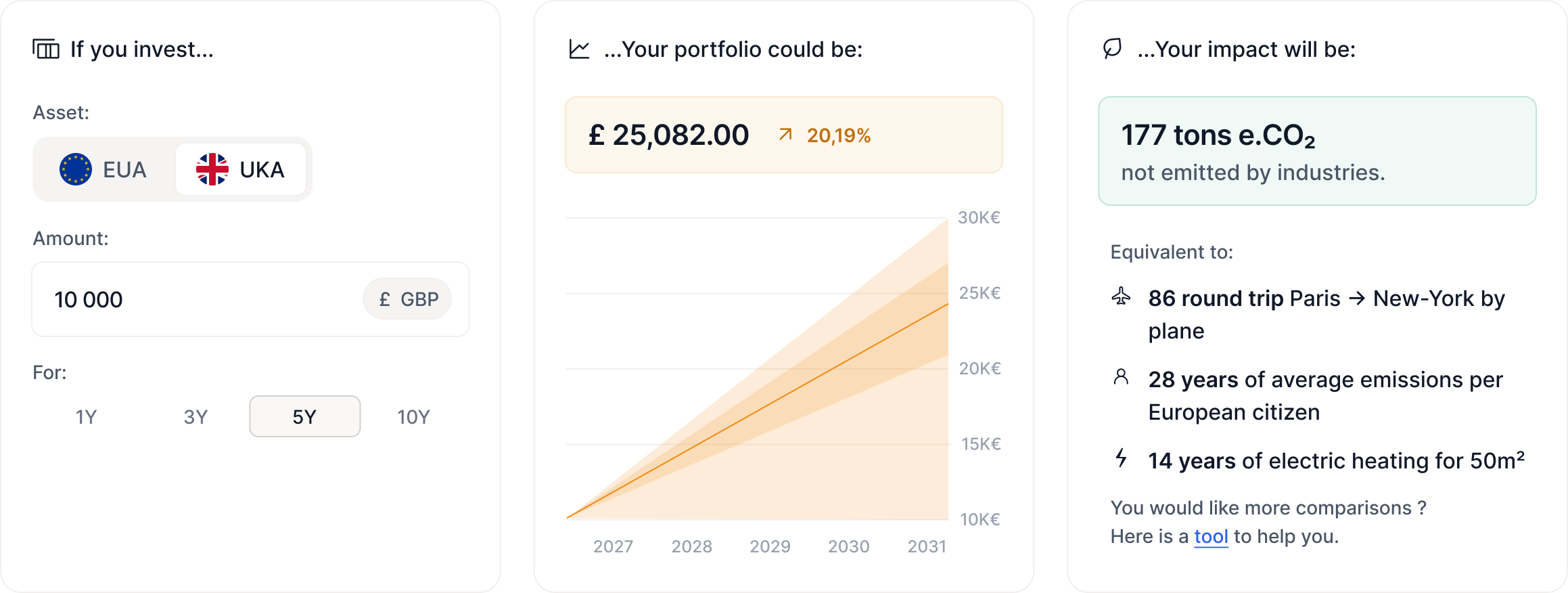
Simulez votre rendement en 2 clics

Découvrez la plue-value que vous auriez pu effectuer si vous aviez investi dans un de nos actifs il y a 1, 5, 10 ans.

Échangez avec un expert

Besoin d’aide ou de plus d’informations ? 
Prenez rendez-vous avec notre expert, il sera ravis de vous accompagner !