How can investing in European Union Allowances accelerate emissions reduction ?

At Homaio, our mission is clear: to design assets with high return potential and a real impact on decarbonization trajectories.
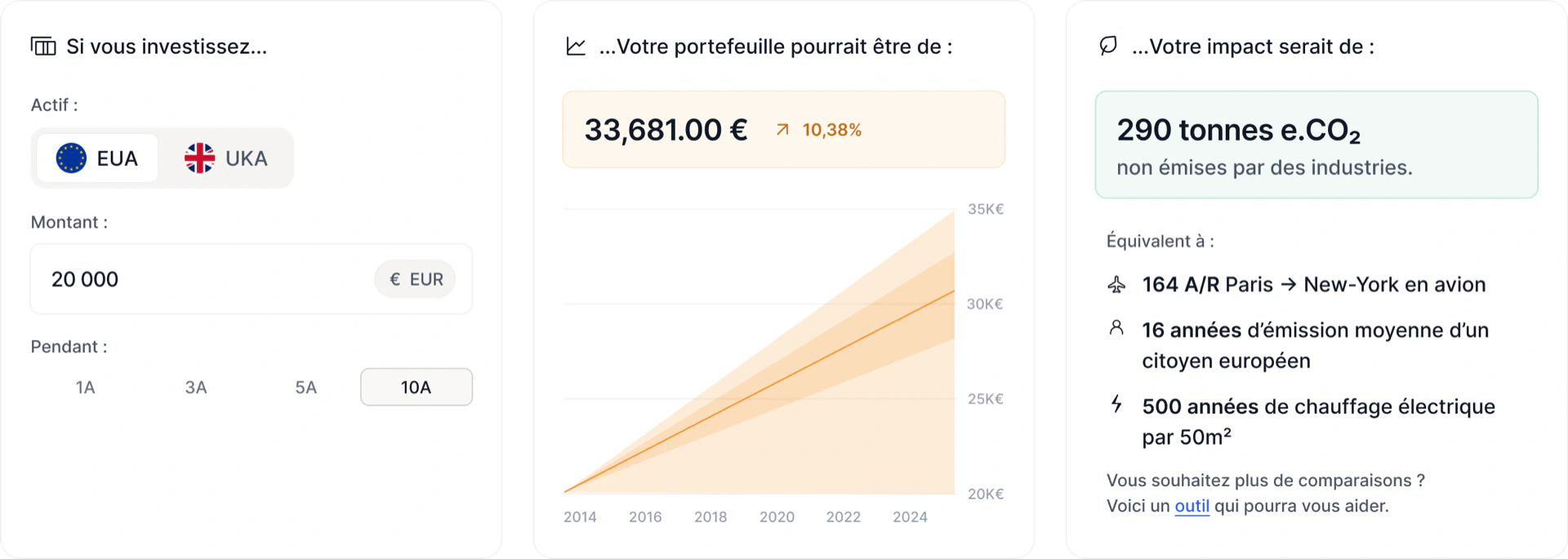
In terms of performance, past results speak for themselves. EU emission allowances (EUAs) have shown an average annual growth of 26.58% over the past ten years.
However, measuring environmental impact is more complex. In our discussions with private investors like you, one question often arises: "What is my impact on this market?"
In this edition of The Homing Bird, we explore how the European Union Emissions Trading Scheme (EU-ETS) contributes to Europe's decarbonization, and what role you play in this dynamic.
Introduction to the European Union Emissions Trading Scheme (EU ETS)
Established in 2005, the EU ETS is a market-based mechanism designed to reduce greenhouse gas emissions. Its principle is to assign a cost to CO2-equivalent emissions, thereby incentivizing the industries subject to it to decarbonize their industrial processes.
To achieve this, the European Commission sets a cap on CO₂-equivalent emissions, which decreases over time. Companies must purchase emission allowances, each representing the right to emit one tonne of CO₂-eq. If they fail to surrender a number of allowances equivalent to their CO2.eq emissions of the year, they face heavy fines. The compliance rate exceeds 97%.
For more details on this mechanism, visit this page.
[[cta-discover]]
The impact of EU-ETS
Putting a price on emissions to decarbonize Europe
Since 2005, the EU ETS has been the cornerstone of the European Union’s climate strategy. This system has proven to be the fairest and most effective tool for reducing greenhouse gas emissions.
Since its inception, emissions from covered sectors (illustrated in the graph below) have decreased by 48%. A meta-analysis published in Nature in 2024 confirms that carbon pricing mechanisms, including the EU ETS, lead to significant emissions reductions—even at modest price levels[1]. The European Environment Agency, in a report published in October 2024, demonstrates that the emissions of sectors covered by the EU ETS have diminished faster than those not covered, or those covered by other policies. Finally, the World Bank, the IMF, and the OECD, and other international organizations also consider emissions pricing to be the fairest and most efficient mechanism to reduce emissions on a massive scale and rapid pace.

In GtCO₂-eq – From 2010 to 2030
Funding the energy transition through a redistributive mechanism
Since 2005, the EU ETS has generated over €200 billion in tax revenues, including nearly €40 billion in 2024. This is because European Union Allowances (EUAs) are a financial instrument issued by the European commission through daily auctions. These funds are thenredistributed to Member States, which are required to reinvest them in their climate policies. In 2023, over €2 billion was allocated to France to fund policies such as MaPrimeRénov'.
A portion of these revenues also funds the European Modernisation Fund and the European Innovation Fund. These funds, in turn, support investments in industrial decarbonization and innovation for the energy transition.
Thus, the higher the value of the allowances, the more funds are available to finance the energy transition, creating a virtuous circle between regulation and industrial transformation.

The impact of private investors
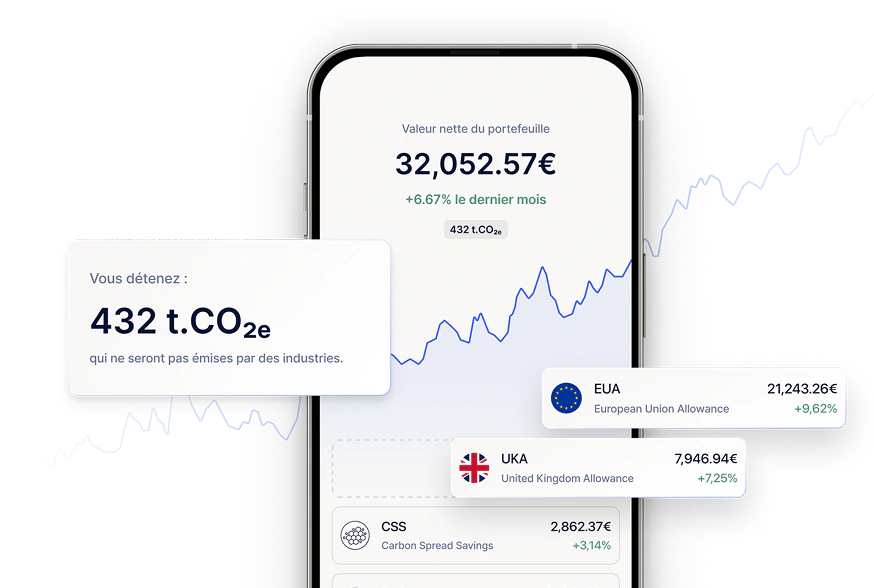
Homaio is the first platform that unlocks European Union Allowances for private investors. When investors subscribe to financial instruments issued by Homaio, Homaio purchases an equivalent number of EUAs on the market, and holds them in the European registry. During all this holding period, a number of effects come into play:

[[cta-guide]]
1. Withholding effect
The purchase of each allowance immediately reduces the number of allowances available in this capped market. Since an allowance must be surrendered for each ton of CO2 emitted, fewer available allowances mean fewer possible emissions.

💡 Every emission avoided today has a positive impact. Indeed, delaying emissions over time helps reduce the concentration of greenhouse gases in the short term and limits climate tipping points.
2. Price effect
Pressure on supply then leads to a price increase, enhancing companies' incentives to invest in decarbonization solutions. The value of an allowance is the break-even point for a decarbonized investment. The higher the price of the allowance, the more competitive it becomes to invest in the decarbonization of an industrial process.

💡 Moreover, these investments are irreversible: companies will not undo their investments, regardless of future fluctuations in the price of allowances.
3. Regulatory effect
When private investors invest through Homaio, it increases the total number of allowances in circulation, leading to a permanent reduction in the cap on allowances issued in subsequent years. This mechanism is derived from a European rule known as "invalidation."
This effect persists even after resale, contributing to restricting the overall supply while accelerating price increases and, consequently, decarbonization trajectories.

4. Maintain a positive impact even after divestment
Even after divesting their EUAs and closing their positions, the positive impact of private investors endures. This is known as residual positive impact. This impact is the sum of the confiscatory, price, regulatory, and temporal effects, net of the allowances being put back on the market.

💡 Homaio supports and funds a research initiative with the Institut Louis Bachelier to model and quantify this impact.
Together, these mechanisms make the EUA market a powerful tool for reducing greenhouse gas emissions, while offering an investment opportunity with high return potential that aligns with ambitious climate goals.