Blog
Carbon Market
Does the EU ETS harm industrial competitiveness?

Does the EU ETS harm industrial competitiveness?

The EU ETS uses policy tools like the Carbon Border Adjustment Mechanism (CBAM) and targeted proceeds redistribution to drive decarbonization while protecting EU industry competitiveness. These mechanisms address carbon leakage and support the transition to sustainable practices, ensuring industries remain competitive internationally amid carbon costs and the move towards green finance.

The European Union Emissions Trading Scheme (EU ETS) is not here to threaten local businesses. It is a sophisticated policy tool that delivers lasting decarbonization while having the necessary mechanisms to protect EU industry competitiveness.

Decarbonization is costly

Decarbonizing industries is inherently costly, and these costs vary not only within sectors but also from one region to another. Energy-intensive industries, such as aluminum, steel, and cement, are particularly vulnerable to these costs. It has been proven that carbon leakage—where companies relocate to countries with less stringent emissions regulations—can occur due to the EU ETS. So, it is legitimate to consider a potential risk to industrial competitiveness. Are some industries more advantageously positioned after facing carbon costs? Is leaving the EU and relocating a better option? The EU ETS is engineered to tackle these challenges.

[[cta-nl]]

Free allocations and competitiveness concerns 

For a long time in the past, free EUAs (European Union Allowances) were distributed to target the most threatened sectors and mitigate the impact of the EU ETS on their competitiveness. This made sure those sectors at risk of carbon leakage were “protected” and kept operating on EU ground. The power sector, less vulnerable to relocation, saw its free allocations decrease faster. However, this was only a temporary solution - free allocations are now being phased out and industrial decarbonization is at the center stage.

The role of the CBAM

The Carbon Border Adjustment Mechanism (CBAM) is an important reform in the EU ETS that will succeed free allowances and keep defending EU competitiveness. CBAM imposes a carbon cost on imported goods, ensuring that producers outside the EU face similar emissions costs. This levels the playing field by preventing non-EU producers from gaining an unfair advantage due to lower carbon costs. By doing so, CBAM aims to protect EU industries from carbon leakage.

[[cta-discover]]

A more targeted proceeds redistribution towards the industry

The proceeds from the sale of EUAs are increasingly being targeted towards the industry. These funds finance green projects that support the transition to sustainable practices. And by better targeting these projects, the EU ETS can contribute more effectively to the industrial sector's decarbonization, while also making sure that industries remain competitive on the international stage.

The EU ETS is continually improving, with adjustments made over time to address real market conditions. The transition from free EUAs to the CBAM is just one example of how the system is gradually evolving.


Partagez cet article via :

Pour aller plus loin

Carbon Market

Can EUAs disappear? 5 reasons the carbon market is here to stay

We are often asked: what if Europe decided to stop the carbon market? Here are 5 reasons why this scenario, while theoretically possible, is in practice highly unlikely.

June 18, 2026

Carbon Market

The Carbon Market Under Political Stress: Temporary Volatility or Paradigm Shift?

As European Union Allowance (EUA) prices recently tested a floor around €70, the market appears to be factoring in an unprecedented "political risk premium." Between Italy’s calls for suspension and Germany’s budgetary debates, are the fundamentals of the world's largest carbon market truly under threat? An analysis of the forces at play as the 2026 legislative review approaches.

June 18, 2026

Carbon Market

CBAM: Europe sets its first carbon border price at €75.36/tCO₂

On 7 April 2026, Europe reached an unprecedented milestone in the history of global climate policy: the European Commission published the first official price under the Carbon Border Adjustment Mechanism (CBAM), set at €75.36 per tonne of CO₂. It is the world's first operational carbon border price.

April 10, 2026

Et si votre épargne finançait la transition climatique ?

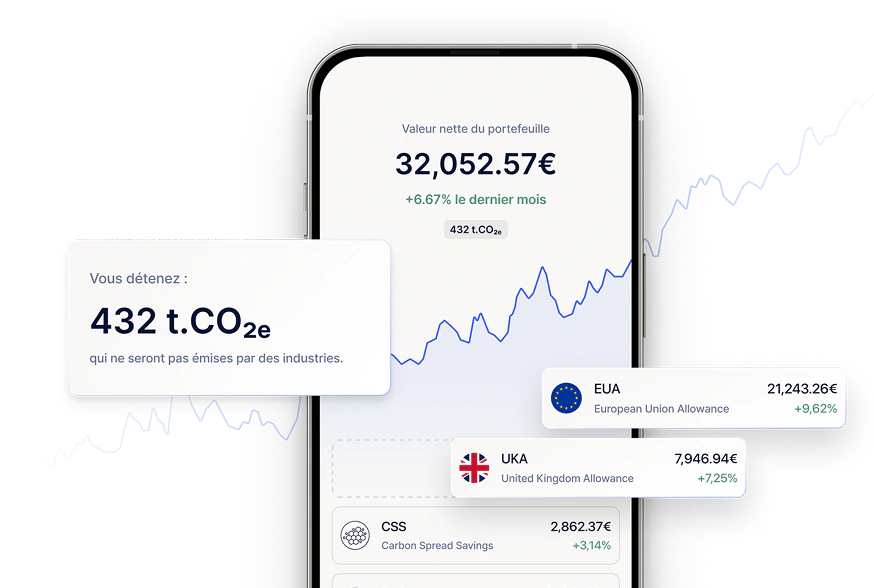
Homaio est la première plateforme qui vous permet d'investir dans les quotas carbone européens (EUA) et britanniques (UKA).

Diversifiez : intégrez les actifs climat à votre patrimoine.

Découvrez Homaio

Finally access investments that combine
financial
 and
environmental
 performance

Et si votre épargne finançait la transition climatique ?

Homaio est la première plateforme qui vous permet d'investir dans les quotas carbone européens (EUA) et britanniques (UKA).

Guide gratuit

Et si votre épargne finançait la transition climatique ?

Homaio est la première plateforme qui vous permet d'investir dans les quotas carbone européens (EUA) et britanniques (UKA).

Guide gratuit
Newsletter

The Homing Bird

5 minutes par semaine pour devenir incollable sur la finance climat.

Simulez votre rendement en 2 clics

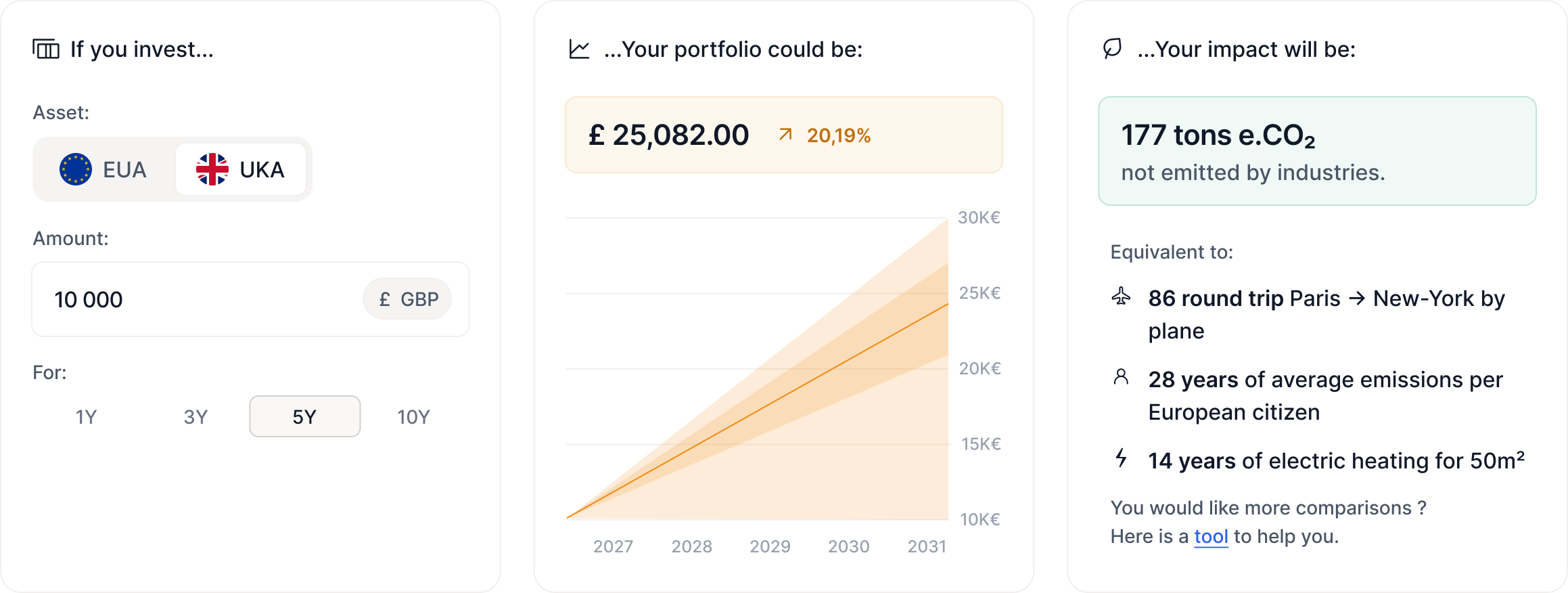
Découvrez la plue-value que vous auriez pu effectuer si vous aviez investi dans un de nos actifs il y a 1, 5, 10 ans.

Échangez avec un expert

Besoin d’aide ou de plus d’informations ? 
Prenez rendez-vous avec notre expert, il sera ravis de vous accompagner !