Difference between a securities account and a PEA: 2026 guide to choosing

You want to invest in the stock market but hesitate between opening a Plan d’Épargne en Actions (PEA) or a standard securities account (CTO)? The main difference lies in their regulatory and tax framework. The PEA is a tax-advantaged wrapper but more restrictive, ideal for long-term investing in European companies. The securities account, on the other hand, offers total investment freedom with no restrictions, but with standard taxation on gains.
Understanding their specific features is the first step to making an informed choice that fits your savings goals and your investment strategy.
PEA or securities account: the difference in a nutshell
To sum up, the comparison comes down to four key points:
- Taxation: The PEA provides an income-tax exemption on capital gains after 5 years of holding. The securities account is subject to the default tax regime (30% flat tax).
- Accessible products: The PEA is limited to shares of European companies. The securities account gives access to all global financial instruments (shares, bonds, ETFs, etc.).
- Contribution cap: The PEA is capped at 150 000 € in contributions. The securities account has no limit.
- Flexibility: The PEA is designed for the long term and penalizes withdrawals before 5 years. The securities account lets you withdraw your money at any time with no constraints.
What is a PEA and what is a securities account?
These two products are “wrappers” that allow you to hold financial assets such as shares. They consist of a cash account for transactions and a securities account where your investments are held.
The PEA: an equity-focused wrapper with a specific tax framework
The Plan d’Épargne en Actions (PEA) is a savings product regulated by the French state. Its goal is to encourage investment in European companies by offering a significant tax benefit. To qualify, you must follow certain rules, including a minimum holding period and a restricted investment universe.
The securities account: a more flexible wrapper for investing
The Compte-titres ordinaire (CTO) is the default vehicle for investing in the stock market. It is not subject to any specific rules: no contribution cap, no geographic restriction, and no withdrawal conditions. This high level of flexibility makes it the preferred tool to diversify your wealth globally, but it offers no special tax advantages.
The main differences between a PEA and a securities account
To make things clearer, let’s compare each wrapper point by point.
[image alt="Comparison table of the main features of the PEA and the securities account for investing in the stock market."]
Taxation
This is the most differentiating criterion. The PEA is a tax shelter. After 5 years, your gains (capital gains and dividends) are fully exempt from income tax. Only social contributions (17,2 % currently) remain due. A withdrawal before 5 years generally leads to the plan being closed and the application of the default CTO tax regime (30 %).
The securities account, by contrast, is subject to the Prélèvement Forfaitaire Unique (PFU), also called the “flat tax”, of 30 % on all gains realized, regardless of the holding period.
Good to know
Taxation is a key factor, but it should not be the only guide for your decision. A less-taxed investment that is less profitable or not aligned with your goals is not necessarily the best choice.
Accessible products
The PEA is deliberately restrictive: it was created to channel savings toward the European economy. You can hold shares of companies headquartered in the EU, Norway, Iceland, or Liechtenstein.
The securities account is a true passport to global markets. It allows you to invest without any limits in U.S. shares (Apple, Google...), Asian shares (Toyota, Samsung...), or any other type of financial product.
Contribution cap and opening conditions
A PEA is limited to 150 000 € in contributions (excluding PEA-PME). You can only hold one per person. The securities account has no contribution limit and you can open as many as you want, with different institutions.
Withdrawals, holding period, and flexibility
The PEA comes with a time constraint. To benefit from its tax advantage and flexibility, you must keep it for at least 5 years. A withdrawal before this anniversary date generally leads to its closure (exceptions exist, such as redundancy).
The CTO offers total liquidity: you can buy and sell securities, and withdraw your funds at any time without affecting the existence of your account.
Securities account or PEA: advantages and disadvantages
Advantages and limitations of the PEA
Advantages:
- Very attractive taxation: the income-tax exemption after 5 years is its main strength.
- Ideal for beginners: its simple framework is perfect for getting started with investing in European markets.
- Start the clock: opening a PEA as early as possible, even with a small amount, starts the 5-year clock.
Limitations:
- Restricted investment universe limited to Europe.
- Contribution cap of 150 000 €.
- Lack of flexibility before 5 years.
Advantages and limitations of the securities account
Advantages:
- Total freedom: access to all products and global markets.
- No cap: ideal for larger portfolios.
- Maximum flexibility: funds are available at any time.
Limitations:
- Standard taxation on capital gains and dividends (30 %).
- Requires good management to avoid overly heavy taxation.
Investing involves risks
Whether through a PEA or a securities account, any stock market investment carries a risk of capital loss. Past performance is not indicative of future performance. Only invest money you are prepared to lose.
What should you choose based on your investor profile?
The choice between a PEA and a securities account depends entirely on your objectives, your investment horizon, and your strategy.
Beginner profile who wants to invest in equities for the long term
If you want to take your first steps in the stock market with a horizon of more than 5 years and focus on European shares, the PEA is often the most relevant choice. Its long-term tax advantage is a powerful driver of performance.
Profile who wants to invest internationally or in more products
If your strategy is to gain exposure to global markets (especially U.S. markets), invest in specific sectors not available in Europe, or use a variety of financial products, the securities account is essential. Its flexibility is unmatched.
Profile seeking to combine tax advantages and diversification
For an experienced investor, the question is not choosing but combining. The most common strategy is to prioritize filling your PEA to benefit from the tax advantage on a European equity portfolio, then use a securities account for everything else: international diversification, specific ethical investments, or simply once the PEA cap has been reached.
Can you have a PEA and a securities account at the same time?
Yes, absolutely. Not only is it possible, it’s even a very common and effective wealth strategy. Holding both lets you get the best of each wrapper: the tax optimization of the PEA and the freedom of the securities account.
For example, you can use the PEA for the core of your long-term portfolio and the CTO for more tactical or diversification investments.
Pro tip
Don’t wait until you have a large amount of capital to open a PEA. The key is to “start the clock” by opening it as early as possible. The 5-year tax clock starts with the very first contribution, even a symbolic one. This way, you’ll have a mature, tax-optimized wrapper ready to use when you want to invest more seriously.
FAQ on the difference between a securities account and a PEA
What is the difference between a PEA and a securities account?
The main difference is tax and regulatory. The PEA is tax-exempt after 5 years but capped (150 000 €) and limited to European shares. The securities account is completely free (no cap, all global products) but its gains are taxed at 30 %.
What’s the point of having a securities account?
The main benefit of the securities account is its flexibility. It allows you to invest without any geographic or product-type constraints, with no contribution cap, and with the ability to withdraw your funds at any time. It’s the perfect tool to maximize diversification of your investment portfolio.
What are the disadvantages of the PEA?
The main disadvantages of the PEA are:
- A risk of capital loss, like any equity investment.
- An investment universe limited to companies in the European Union.
- A contribution cap of 150 000 €.
- Penalizing taxation and reduced flexibility in the event of a withdrawal before 5 years.
Can you have a securities account and a PEA at the same time?
Yes, it is entirely possible and even recommended to hold both. This makes it possible to combine the PEA’s tax advantage for a long-term European equity portfolio with the securities account’s flexibility for international diversification or to invest beyond the PEA cap.
*Disclaimer: The information presented in this article is for educational purposes and in no way constitutes personalized investment advice. Investing in financial markets involves risks of capital loss. Regulations and taxation may change. Before making any decision, it is recommended that you consult professional advisors and verify information with official sources.*
Go further: invest in the carbon market
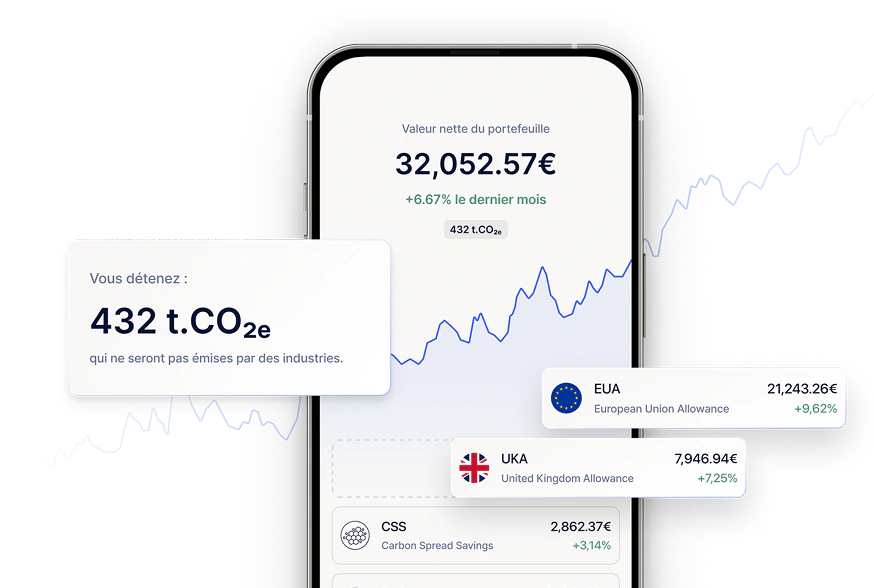
Homaio gives you access to European carbon allowances (EUAs), an asset class that combines potential financial performance with direct climate impact. Diversify your wealth with an asset uncorrelated from traditional markets, accessible from €1,000.