Blog
Carbon Market
Are EUAs official financial instruments?

Are EUAs official financial instruments?

EU Allowances (EUAs) are now official EU financial instruments, evolving from compliance tools to sophisticated assets since 2018, attracting investors and enabling carbon market trading for both returns and environmental impact within the European carbon market. Investing in carbon allowances, like EUAs, is an example of green investment and responsible investment.

Under EU law, European Union Allowances (EUAs) are classified as official financial instruments. Traded on exchanges within the European Union Emissions Trading Scheme (EU ETS) marketplace, EUAs have quantifiable financial characteristics just like other financial assets.

The trading asset of a cap-and-trade

A cap-and-trade system, as its name implies, involves trading. Although it is fundamentally a regulatory tool designed to manage emissions, it depends on market mechanisms to establish an effective carbon price. To facilitate this, it requires a tradable financial instrument. EUAs were created for this very purpose, allowing the market to determine the price of carbon. Unlike a carbon tax system, where regulators set the price unilaterally, an ETS lets the free market establish the carbon price.

[[cta-nl]]

Initially trading EUAs for compliance purposes only

In the early years of the EU ETS, up until 2018, EUAs were only used for compliance trading. During this period, EUAs were mainly exchanged by industries and power producers that needed them to meet their emission reduction targets. They had less financial features and were not yet seen as the complex financial instruments that they have become today. Instead, their role was largely regulatory, focused on helping companies comply with emissions regulations rather than being as advanced of financial products as they are today.

EUAs recognized as official financial instruments under EU law

EUAs came under the scope of the Markets in Financial Instruments Directive II (MiFID II) in 2018. This means that EUAs officially became financial instruments under European law

MiFID II aims to make financial markets more transparent and protect investors. With this new framework, a wider range of participants were allowed to trade EUAs. This shift increased the liquidity and overall strength of the EU ETS market.

[[cta-discover]]

A sophisticated financial asset 

Since EUAs were brought under MiFID II, they have evolved into sophisticated financial tools. The market for carbon allowances now includes a wide range of participants, including investment firms and credit institutions, going beyond just industries and power producers. Starting in 2024, individual investors have also joined the EU ETS market.

EUAs are now analyzed using metrics like return on investment (ROI), volatility, market correlations, risk-reward measure... This has led to the development of technical trading strategies and specialized trading desks focusing on EUAs. 

Carbon allowances have gone from simple compliance tools into elaborate financial assets bringing both returns and positive environmental impact.

Partagez cet article via :

Pour aller plus loin

Carbon Market

Can EUAs disappear? 5 reasons the carbon market is here to stay

We are often asked: what if Europe decided to stop the carbon market? Here are 5 reasons why this scenario, while theoretically possible, is in practice highly unlikely.

June 18, 2026

Carbon Market

The Carbon Market Under Political Stress: Temporary Volatility or Paradigm Shift?

As European Union Allowance (EUA) prices recently tested a floor around €70, the market appears to be factoring in an unprecedented "political risk premium." Between Italy’s calls for suspension and Germany’s budgetary debates, are the fundamentals of the world's largest carbon market truly under threat? An analysis of the forces at play as the 2026 legislative review approaches.

June 18, 2026

Carbon Market

CBAM: Europe sets its first carbon border price at €75.36/tCO₂

On 7 April 2026, Europe reached an unprecedented milestone in the history of global climate policy: the European Commission published the first official price under the Carbon Border Adjustment Mechanism (CBAM), set at €75.36 per tonne of CO₂. It is the world's first operational carbon border price.

April 10, 2026

Et si votre épargne finançait la transition climatique ?

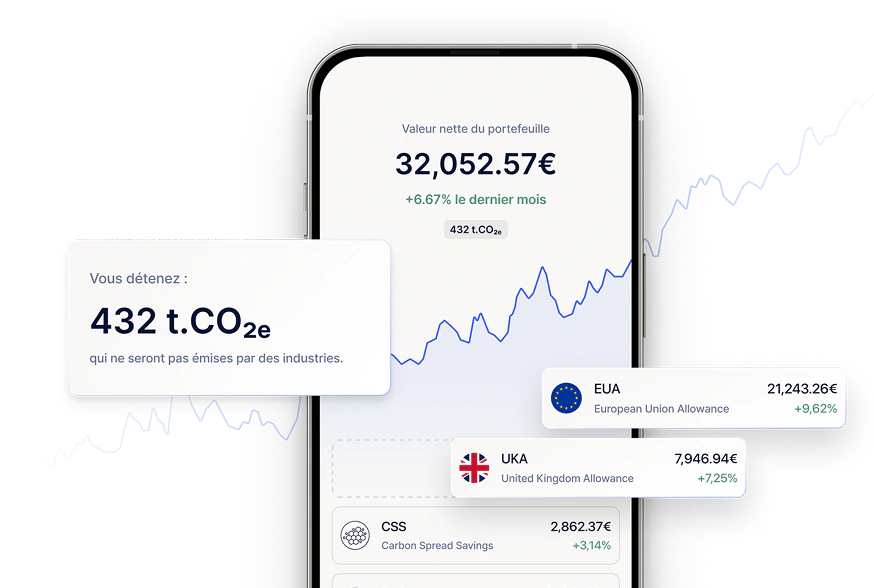
Homaio est la première plateforme qui vous permet d'investir dans les quotas carbone européens (EUA) et britanniques (UKA).

Diversifiez : intégrez les actifs climat à votre patrimoine.

Découvrez Homaio

Finally access investments that combine
financial
 and
environmental
 performance

Et si votre épargne finançait la transition climatique ?

Homaio est la première plateforme qui vous permet d'investir dans les quotas carbone européens (EUA) et britanniques (UKA).

Guide gratuit

Et si votre épargne finançait la transition climatique ?

Homaio est la première plateforme qui vous permet d'investir dans les quotas carbone européens (EUA) et britanniques (UKA).

Guide gratuit
Newsletter

The Homing Bird

5 minutes par semaine pour devenir incollable sur la finance climat.

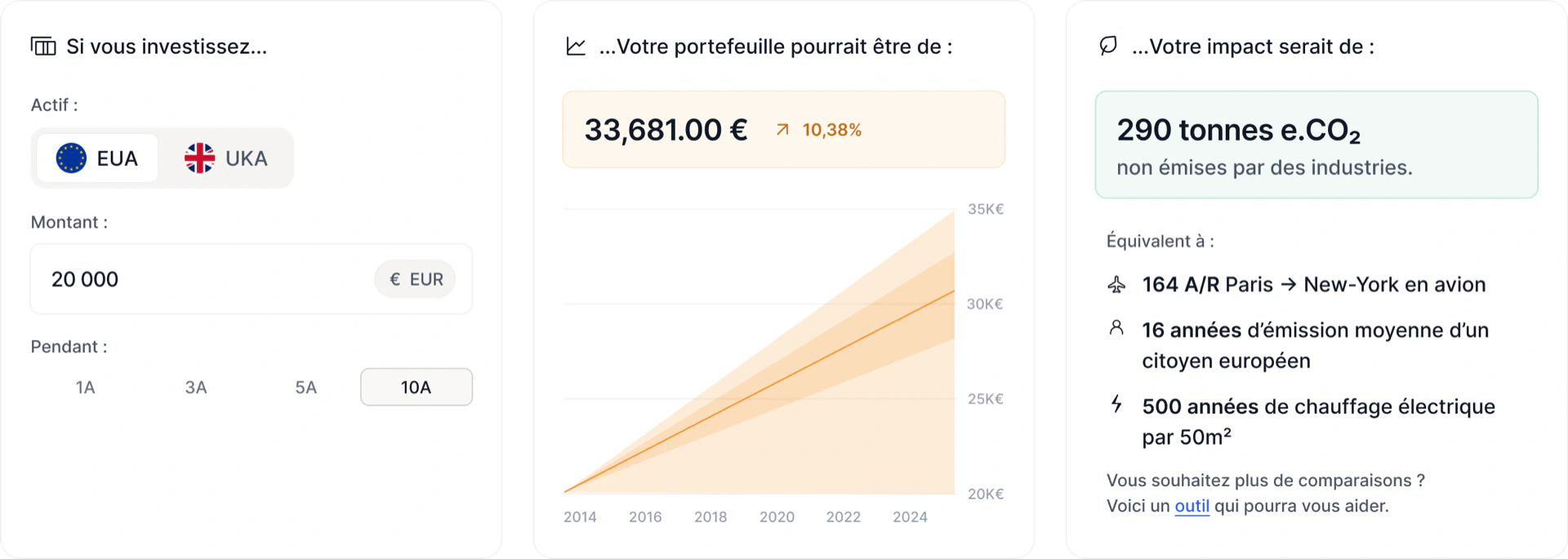
Simulez votre rendement en 2 clics

Découvrez la plue-value que vous auriez pu effectuer si vous aviez investi dans un de nos actifs il y a 1, 5, 10 ans.

Échangez avec un expert

Besoin d’aide ou de plus d’informations ? 
Prenez rendez-vous avec notre expert, il sera ravis de vous accompagner !