Blog
Marché Carbone
Does my investment still have a climate impact if I sell my EUAs?

Does my investment still have a climate impact if I sell my EUAs?

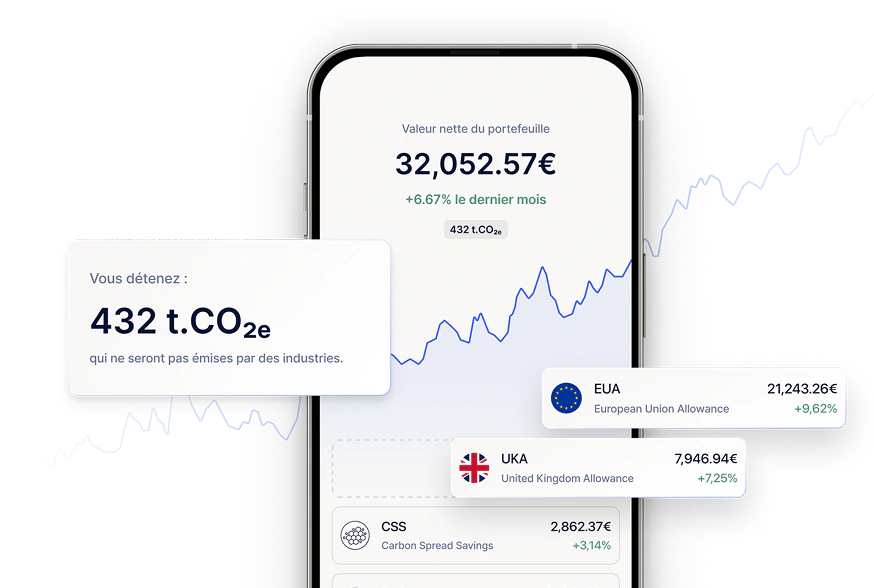
Investing in carbon allowances (EUAs) helps delay CO₂ emissions by temporarily removing these allowances from the market. This action contributes to increasing the carbon price, encouraging industries to invest in decarbonization solutions and fostering a more efficient market for the hardest-to-abate emissions. By holding and strategically selling EUAs, the investment plays a key role in driving the transition toward a sustainable economy.

Delaying CO₂ emissions

Owning EU Allowances (EUAs) is, in essence, a way to delay carbon emissions. When you buy EUAs, you temporarily remove them from the carbon market — meaning they can’t be used by industrial facilities until you decide to sell them.
This withdrawal reduces the number of allowances available at any given time, directly limiting how much CO₂ can be emitted. By holding your EUAs for as long as possible, you’re not only acting as an investor — you’re actively constraining carbon supply and creating a measurable climate impact.

Extending your impact on the EU carbon market

Holding your EUAs longer strengthens and extends your influence on the EU Emissions Trading System (EU ETS). A tighter market and higher prices push companies to accelerate their transition and adopt cleaner technologies.
Some decarbonization solutions are already technically and economically ready — but without sufficient carbon price pressure, industries might delay their adoption. By keeping your EUAs off the market, you help sustain that pressure and encourage long-term investment in green innovation.

[[cta-impact]]

Benefiting from price appreciation

EUA prices are designed to increase over time as the EU tightens its emissions cap. The longer you hold your allowances, the greater the potential upside. Rising carbon prices not only benefit investors — they also make low-carbon technologies more competitive, driving faster adoption across industries.
You can decide how long to hold your EUAs based on price trends and the pace at which decarbonization technologies become viable (as shown by the MACC curve).

Selling into a more efficient market

When you eventually sell your EUAs, the market will likely look very different. Fewer allowances will be available due to stricter EU targets, and industries will have already tackled the easiest emissions to cut.
By that stage, your EUAs will be used for the most difficult — yet still essential — emissions that keep the European industrial system running. Selling in such a context ensures your allowances contribute where they matter most.

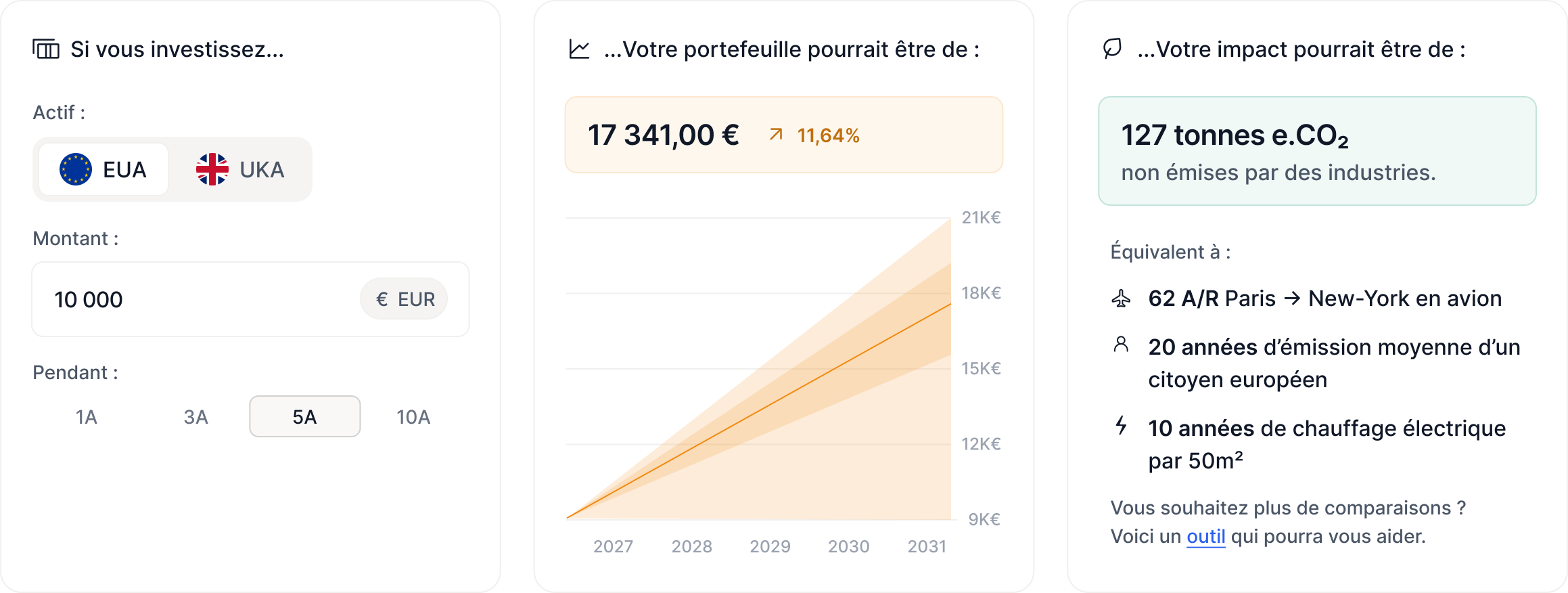
[[cta-simulator]]

Your climate influence

By investing in EUAs, you’re taking an active role in shaping the carbon market. You delay emissions, contribute to tightening the EU ETS, and support the long-term appreciation of carbon prices — all of which accelerate industrial decarbonization.
Your impact goes well beyond holding and selling allowances. It’s a tangible contribution to building a more sustainable, low-carbon economy.


Partagez cet article via :

Pour aller plus loin

Marché Carbone

Les EUA peuvent-ils disparaître ? 5 raisons pour lesquelles le marché carbone est là pour durer

On nous pose souvent la question : et si l'Europe décidait d'arrêter le marché carbone ? Voici pourquoi ce scénario, bien que théoriquement possible, est en pratique hautement improbable.

June 18, 2026

Marché Carbone

Le marché du carbone à l'épreuve de la politique : volatilité passagère ou changement de paradigme ?

Alors que le prix des quotas européens (EUA) a récemment testé un plancher autour de 70 €, le marché semble intégrer une "prime de risque politique" inédite. Entre les velléités de suspension du système en Italie et les débats budgétaires en Allemagne, les fondamentaux du plus grand marché carbone au monde sont-ils réellement menacés ? Analyse des forces en présence à l'approche de la révision législative de 2026.

June 18, 2026

Marché Carbone

Un prix du carbone élevé est la condition de la compétitivité européenne

Depuis le début de l'année 2026, le Système d’Échange de Quotas d’Émissions (SEQE) européen fait l'objet d'une offensive politique et industrielle coordonnée, accusant le prix du carbone de plomber la compétitivité du continent. Dans cet article, Valentin Lautier démontre qu'affaiblir ce mécanisme serait au contraire un contresens économique et une grave erreur stratégique. En s'appuyant sur l'analyse des coulisses du "flash crash" de février-mars 2026 et sa stabilisation par le Conseil Européen, cet article décrypte l'articulation profonde entre le signal-prix du carbone, la souveraineté énergétique (face à la dépendance au gaz importé) et le financement de l'innovation de rupture (MACF/CBAM, aciers et ciments bas-carbone). À l'heure où la Chine accélère sa transition pour devenir le premier électro-état mondial, un prix du carbone fort et prévisible n'est pas une menace pour l'Europe : c'est la condition nécessaire à sa réindustrialisation et à son indépendance géopolitique.

May 21, 2026

Et si votre épargne finançait la transition climatique ?

Homaio est la première plateforme qui vous permet d'investir dans les quotas carbone européens (EUA) et britanniques (UKA).

Diversifiez : intégrez les actifs climat à votre patrimoine.

Découvrez Homaio

Accédez enfin à des investissements qui combinent
financier
et
environnementale
performance

Et si votre épargne finançait la transition climatique ?

Homaio est la première plateforme qui vous permet d'investir dans les quotas carbone européens (EUA) et britanniques (UKA).

Guide gratuit

Et si votre épargne finançait la transition climatique ?

Homaio est la première plateforme qui vous permet d'investir dans les quotas carbone européens (EUA) et britanniques (UKA).

Guide gratuit
Newsletter

The Homing Bird

5 minutes par semaine pour devenir incollable sur la finance climat.

Simulez votre rendement en 2 clics

Découvrez la plue-value que vous auriez pu effectuer si vous aviez investi dans un de nos actifs il y a 1, 5, 10 ans.

Échangez avec un expert

Besoin d’aide ou de plus d’informations ? 
Prenez rendez-vous avec notre expert, il sera ravis de vous accompagner !